← All posts

Alterno Is Attempting Crypto Crowdfunding?! (SAND - Part 20)

Alterno Is Attempting Crypto Crowdfunding?! (SAND - Part 20)

TL;DR: SandBlock reads like a retail crypto-funding product wrapped around a renewable-energy pitch. The public docs advertise USDT investment, tiered APY, weekly payouts, and principal payback. The visible Git history and an older TriipMiles-Dfinity archive point to the same contractor handle, chipchipzero, which is at least consistent with an external-build pattern.

As we continue to navigate the complexities of the Sand Battery dispute, my focus remains strictly on documenting the objective, verifiable truth. In the digital age, corporate narratives are easily manufactured, but code commits, repository histories, and digital footprints leave an undeniable trail of reality.

Recently, a new public repository emerged under the official Alterno-Group GitHub organization named sandblock. A careful analysis of this repository provides profound clarity regarding the company's current engineering capabilities and its sudden, strategic shift in fundraising tactics.

The Strategic Pivot: Unregulated Retail Capital

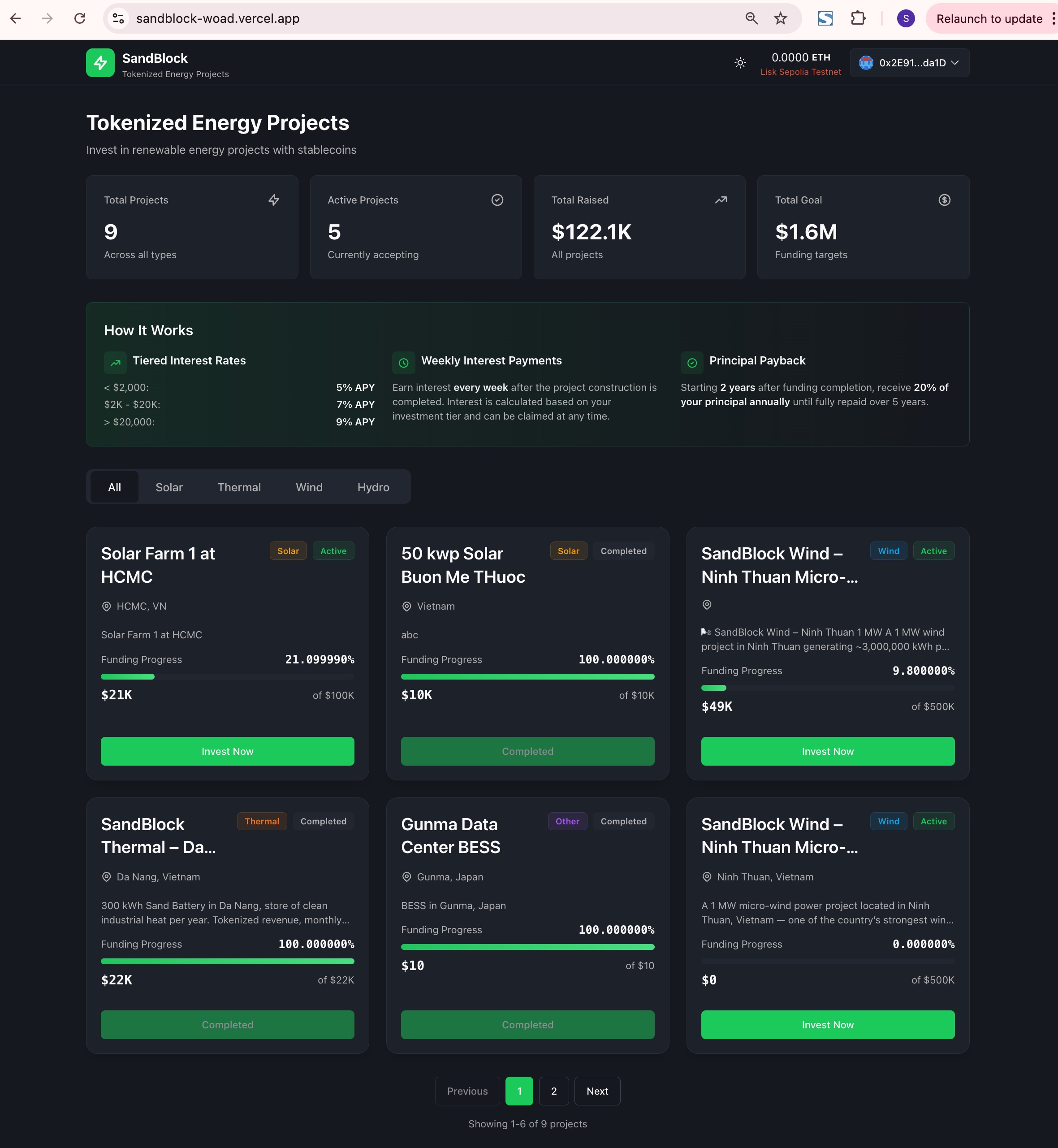
According to the repository's own documentation, SandBlock is engineered as a "Tokenized Energy Investment Platform". It operates as a decentralized application (dApp) designed to allow retail users to invest directly in renewable energy projects using cryptocurrency, specifically USDT.

The platform's frontend and smart contracts advertise enticing financial returns: tiered interest rates of 5-9% APY based on the investment amount, weekly interest payouts, and a scheduled 20% annual principal payback.

This represents a drastic operational pivot. Up until now, Alterno has actively pursued traditional venture capital and grants from established institutional partners. However, following the corporate restructuring maneuvers and illegal dissolution attempts in Vietnam documented in SAND Part 19, traditional VC due diligence became an insurmountable legal hurdle. Creating a Web3 tokenization platform signals an attempt to bypass institutional scrutiny altogether, extracting unregulated retail capital directly from the public while masking ongoing legal battles and intellectual property disputes.

SandBlock Vercel deployment / homepage UI

The Illusion of In-House Engineering

A core component of Alterno's public narrative, specifically championed by CTO Nam Nguyen, has been the assertion that the company's engineering team handles all complex technical development strictly in-house. It was previously claimed that my technical contributions were negligible.

However, we must look at the objective data. The sandblock repository shatters this narrative.

First, the codebase is not a proprietary, ground-up technological breakthrough. It relies heavily on pre-existing boilerplate templates, specifically utilizing the Scaffold-ETH 2 framework, NextJS, Hardhat, and Wagmi. Furthermore, the repository currently sits with zero stars, zero forks, and zero organic developer community engagement.

Most crucially, a review of the commit history reveals that CTO Nam Nguyen has not contributed a single line of code to this project. In fact, there are no internal Alterno engineers listed in the commit logs. The sole contributor to the entire SandBlock repository is an external developer operating under the handle "chipchipzero" (Khánh Mạc).

Alterno-Group/sandblock GitHub commit history showing chipchipzero as the sole contributor

The Triip.me Connection and Recurring Patterns

The reliance on this specific external developer is not a coincidence; it exposes a recurring operational pattern by Alterno's CEO, Hai Ho.

Before Alterno was founded, Hai Ho and I worked together at Triip.me, a company where he served as Chairman for over a decade. During my tenure as CTO from 2018 to 2019, Triip.me also made a significant pivot into Web3 and tokenization, launching the TriipMiles ICO.

If you cross-reference the GitHub histories between these two seemingly distinct companies, a clear proxy relationship emerges. The exact same external contractor, "chipchipzero," is documented executing code merges and building the smart contracts for the old TriipMiles-Dfinity repository over four years ago.

Comparison of chipchipzero commit profile across SandBlock and the old Triip.me crypto repo

Conclusion: Spectacles Over Substance

In the tech industry, building complex digital infrastructure requires deep, sovereign technical competence. The SandBlock project demonstrates that when tasked with executing a new software architecture, the current management team lacks the internal capacity they publicly claim to possess.

Instead, they have recycled the exact same external proxy used in their previous crypto ventures to quickly assemble a blockchain storefront using boilerplate code. This appears to be a calculated spectacle—a shiny Web3 distraction designed to secure quick, unregulated funding while masking severe internal technical deficiencies and ongoing legal battles over the core Sand Battery IP.

As we uncover in SAND Part 21, SandBlock is not an isolated Web3 experiment; it is the newest funding node in a multi-jurisdictional network of Singapore holding companies, offshore entities, questionable supplier payment patterns, and VC due-diligence gaps. As the legal proceedings advance, the evidence speaks for itself, and the chronological truth will remain available for anyone willing to look past the PR.