Back to Blog

    How does Sand Battery cut 50% of your Heating cost? (SAND - Part 2)

    #sandbattery#innovation#enterpreneur

    Continuing from

    Part 1

    , where I introduced the Sand Battery, detailed its innovative design, and unpacked the physics behind its ability to store and release thermal energy efficiently, we now dive deeper into a practical application.

    In this Part 2, I’ll illustrate how the Sand Battery can save up to 50% or more of energy costs in a specific industrial use case, focusing on the calculation of thermal energy cost savings. Let’s break it down step by step and then explore how this technology can address the solar "duck curve" a critical challenge in renewable energy adoption.

    The calculation of Thermal Energy cost savings

    To demonstrate the Sand Battery’s potential, let’s consider a typical industrial scenario, such as a factory in Vietnam utilizing a fluid bed dryer for production. This real-world example is drawn from a prospect we’re engaging with, and it highlights the practical benefits of our technology. Here’s how the savings unfold:

    Step 1: Storing 'cheap' Grid Electricity

    In Vietnam, electricity tariffs fluctuate significantly throughout the day. During off-peak hours from 10 PM to 4 AM, the tariff drops to approximately one-third of the peak rate. For instance, if the peak tariff is around 2,900 VND/kWh, the off-peak rate might be closer to 1000 VND/kWh. We can harness this cost advantage by storing 100 kWh of this inexpensive electricity into the Sand Battery by heating the sand block. With the 98% efficiency I mentioned in Part 1, validated through our lab tests and a known benchmark in energy conversion.

    Step 2: Storage and Heat Loss

    Once stored, the challenge is keeping that energy. Based on our lab tests and comparisons with competitors’ data, we’ve determined that heat loss ranges from 5% to 10% per day under ideal conditions. This is an ambitious target, and while we’re not there yet, we do have a concrete roadmap, based on labs data, outlines optimization strategies like improved insulation and material enhancements to achieve this. For a 24-hour cycle, we’ll assume a heat loss of 5% (high-end) to 10% (low-end) to reflect this variability.

    Step 3: Heat Extraction Efficiency

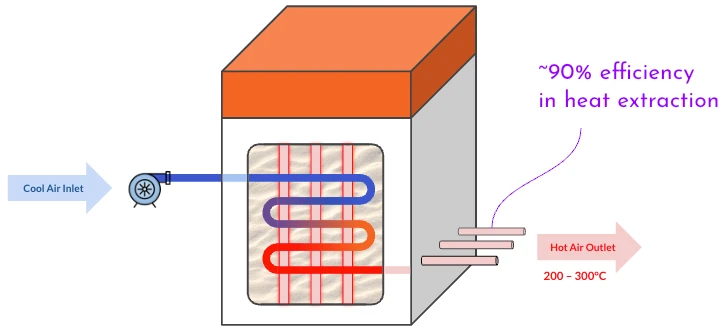
    The next phase involves extracting the stored heat for use. Air is pushed through the Sand Battery via a fan, traveling through pipes to the output (as illustrated in the system diagram from Part 1). Some electricity is consumed to run the fan, and heat is lost at exposed piping sections despite additional insulation. Our lab data indicates an extraction efficiency of approximately 90%, meaning we recover about 90% of the stored energy for practical use. This efficiency can vary slightly (down to 80% in less optimal conditions), but 90% is a reliable average based on our tests.

    Step 4: Putting it all together

    Let’s apply these figures to our industrial use case: a fluid bed dryer in Vietnam, where the stored energy is fully consumed within 24 hours to support production, initiating a new cycle thereafter. This mirrors the operational pattern of our prospect, who sees the Sand Battery as a fit for their existing setup

    Reference

    http://www.bestdryermachine.com/related-post/fluid-bed-dryer-working-principle.html

    • High-End Calculation:
      Starting with 100 kWh at 98% efficiency (98 kWh stored), minus 5% heat loss over 24 hours (93.1 kWh remaining), and 90% extraction efficiency yields 83.79 kWh of thermal energy recovered for production.

    • Low-End Calculation:
      Starting with 100 kWh at 95% efficiency (95 kWh stored), minus 10% heat loss over 24 hours (85.5 kWh remaining), and 80% extraction efficiency yields 68.4 kWh of thermal energy recovered for production.

    Thus, the Sand Battery delivers 68–83% of the initial energy for use, purchased at one-third the peak tariff (e.g., 1000 VND/kWh vs. 2,900 VND/kWh). Normalizing this against the peak cost, the savings range from 51% to 60% a remarkable efficiency boost! This calculation proved the Sand Battery’s potential to slash energy expenses, making it a game-changer for Thermal applications.

    Solving the Solar "duck curve"

    Now, let’s extend this potential to a broader challenge: the solar "

    duck curve

    ", a phenomenon that threatens the stability of renewable energy grids. The duck curve arises when solar power generation peaks during midday but drops sharply in the evening, creating a steep ramp-up demand (the "belly") as traditional power sources kick in. This mismatch strains grids, increases costs, and risks blackouts, particularly in regions like Vietnam with growing solar adoption.

    From

    https://www.synergy.net.au/Blog/2021/10/Everything-you-need-to-know-about-the-Duck-Curve

    The Sand Battery offers a solution by shifting excess solar energy - produced during the day when supply outstrips demand - into stored thermal energy for use during peak evening hours. Here’s how:

    • Capturing Excess Solar Energy: During most sunny hours (e.g., 10 AM–2 PM), solar panels often generate surplus electricity. In Vietnam, where solar capacity is expanding, this excess can be diverted to heat the Sand Battery, storing up to 100 kWh or more with 98% efficiency, as demonstrated earlier. Government policies only buy up to 20-30% of the excess energy generated, the rest we could easily dump into Sand Batteries instead of just wasting it. Imagine, we can get this excess electricity at even cheaper tariff as energy source!

    • Bridging the Evening Gap: As solar production wanes (4 PM–8 PM, the duck’s “neck”), the stored thermal energy can be extracted (90% efficiency) to power industrial processes - like our fluid bed dryer example. This flattens the demand curve, reducing reliance on expensive peak tariffs or fossil fuels.

    • Cost Savings and Grid Stability: By using stored energy at night (e.g., 10 PM–4 AM) or during peak evening demand, factories could save 51–60% on energy costs, as calculated. On a grid level, this reduces the need for rapid ramp-up of conventional power plants, mitigating the duck curve’s impact and supporting Vietnam’s renewable energy goals.

    • Scalability: For larger implementations, multiple Sand Batteries can be networked, storing hundreds of megawatt-hours of solar energy. The technical roadmap includes optimizing heat loss (5–10% target) and extraction efficiency (90% benchmark), and durability of the solution (more than 20 years)

    • Preventing Catastrophes: The recent blackout in Spain on

      May 2, 2025

      , highlighted the vulnerability of grids heavily reliant on renewables, where poor management and inadequate connections led to a collapse. The Sand Battery’s ability to store excess solar energy and release it strategically enhances grid stability, preventing such catastrophes by providing a reliable buffer against sudden demand spikes or generation losses, ensuring a more resilient energy system.

    This approach not only addresses the duck curve but also could position the Sand Battery as a cornerstone for Vietnam’s clean energy transition, made in Vietnam for the world, if we do it right.


    Continue reading

    Part 3

    – Sand Battery produces almost Zero emission during the entire lifetime.